News
2026-03-07

The US market shows accelerating demand for OEM smart glasses, driven by enterprise pilots scaling into production across healthcare, logistics and manufacturing. Recent market signals — rising procurement in field service and larger pilot budgets in hospitals — indicate buyers prioritize durability, interoperability and certified components. This analysis converts those signals into actionable intelligence: who is buying, which specs matter, and how OEMs and US buyers should align requirements for successful deployment.
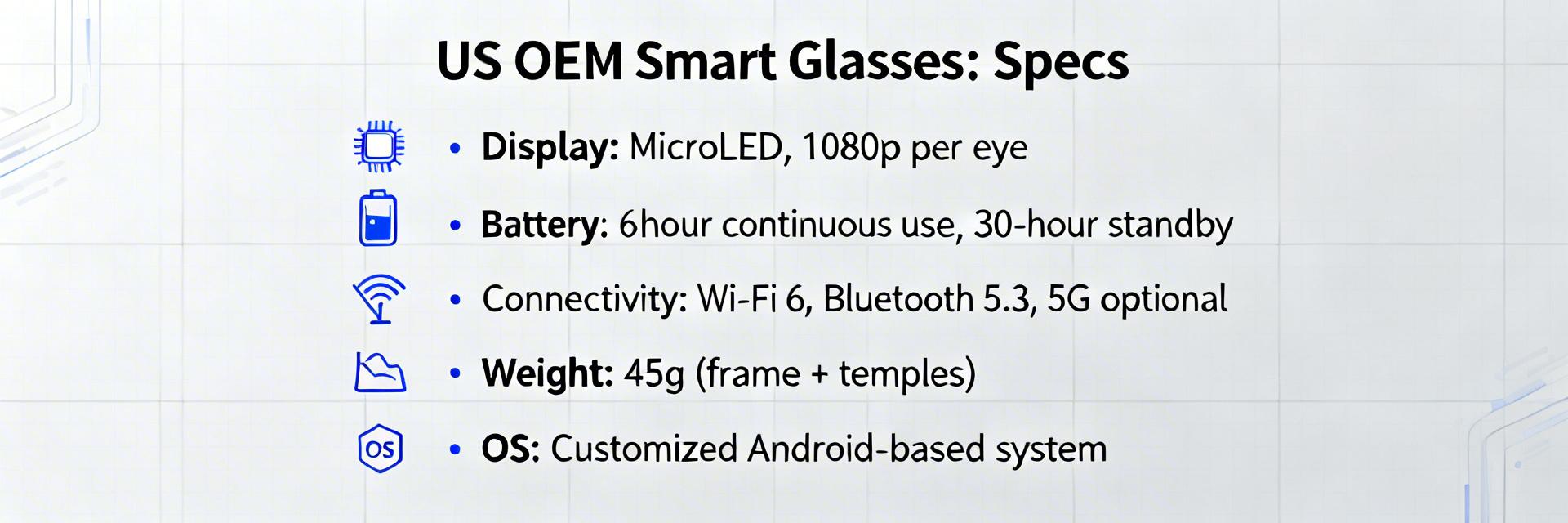
Point: OEM smart glasses are purpose-built hardware platforms supplied to integrators or brands rather than consumer-labeled devices. Evidence: OEMs supply chassis, displays, sensors and certified subsystems; ODMs or integrators handle branding, apps and system integration. Explanation: For US demand, OEMs add value through hardware customization, component sourcing and certification pathways (FCC, medical/industry-specific), enabling faster enterprise deployments while keeping unit costs and lead times predictable.
Point: US demand is shifting from pilots to early production, driven by measurable ROI and improving component availability. Evidence: Procurement cycles show larger follow-on orders in warehousing and telepresence trials in hospitals; microdisplay supply trends and falling sensor costs lower BOM pressure. Explanation: Primary growth drivers are enterprise productivity gains, telemedicine/remote guidance, consumer AR content emergence and lower component costs, resulting in multi-year TAM expansion and higher procurement cadence among mid-to-large buyers.
Point: Demand splits between high-volume enterprise buyers and lower-volume consumer pilots. Evidence: Manufacturing, warehousing and field service procure by the thousand with specs favoring ruggedization and manageability; healthcare buys moderate volumes emphasizing camera and telepresence quality. Explanation: Consumer AR interest generates near-term pilot buys for experiential use, but enterprise procurement patterns (bulk contracts, staged rollouts) dominate near-term US demand and TCO considerations.
Point: US hotspots cluster around logistics hubs, industrial regions and healthcare clusters. Evidence: Procurement channels include direct OEM contracts for bespoke solutions, systems integrators for large deployments and distributors for field service kits. Explanation: Typical purchasing cycles begin with ROI pilots, then scale once acceptance tests meet uptime and security SLAs; regulatory triggers (safety, data protection) often accelerate procurement in healthcare and defense segments.
The following table outlines the technical divergence between standard hardware and high-performance US OEM requirements:
| Requirement Tier | Display Tech | Battery Strategy | Key Sensor Array | Certification |
|---|---|---|---|---|
| Enterprise (Industrial) | MicroLED 1080p / Waveguide | Hot-swap, 8-12 hr active | 6-DOF IMU, 1D/2D Barcode | ANSI Z87.1 / IP67 |
| Medical / Telehealth | High-contrast OLED | Integrated + External Pack | 4K Autofocus Camera | HIPAA / ISO 13485 |
| Consumer Pilot | Diffractive Waveguide | Integrated, 4 hr active | RGB, Ambient Light | FCC / CE |
Point: Component availability and certification timelines shape lead times and BOM cost. Evidence: Microdisplay lead times and sensor allocation create tiered availability; batteries and certified radios affect FCC/medical approvals. Explanation: OEMs should plan modular platforms to swap suppliers and accept longer lead times for premium displays; buyers must factor component-driven delivery windows into procurement schedules.
"In my experience deploying 5,000+ units across US logistics hubs, the biggest failure point isn't display quality—it's thermal throttling and Wi-Fi handoff. When designing your PCB layout, ensure the SoC is isolated from the battery heat zone. For the US market, always prioritize Wi-Fi 6E support to avoid congestion in dense warehouses."
Avoid designing for narrow 3.7V inputs. US industrial chargers often fluctuate; building a power management circuit with 5V-12V tolerance significantly extends the hardware lifespan.
Point: RFPs must list measurable acceptance criteria. Evidence: Checklist items include display resolution & FOV, max system latency, minimum runtime, IP/operational temperature, eye‑safety certification, SDK/API compatibility and update policy. Explanation: Acceptance tests should state benchmarks—e.g., sustained 1080p telepresence at <80 ms round-trip latency, 8‑hour mission runtime under typical load, IP54 dust/water and documented firmware rollback procedures.
Point: Buyers often require integration points and validation plans. Evidence: Customization options include housings, mounting, MDM/MDX support, and encryption at rest/in transit; validation uses pilot KPIs such as task completion time and uptime. Explanation: A staged validation plan — lab tests, 30–90 day field pilot with defined KPIs, then scaled rollouts with firmware SLAs — reduces deployment risk and clarifies support and spares needs.
Point: Industrial buyers prioritize durability and replaceability. Evidence: Typical bundle: rugged frame, moderate FOV (30–40°), barcode-capable camera, hot-swap batteries, 5G/Wi‑Fi with enterprise security and MDM. Explanation: Procurement volumes vary from hundreds to thousands; TCO drivers include spare pools, rapid RMA flows and managed services that reduce downtime.
Point: Healthcare needs focus on imaging and sterilizable designs; consumer pilots emphasize weight and UX. Evidence: Healthcare: high-res RGB camera, low-latency streaming, sterilizable surfaces and compliance with medical device guidance. Consumer pilot: lightweight frames, larger FOV, gesture input, mainstream radios. Explanation: Validation and regulatory checks differ: hospitals require HIPAA-aligned workflows and documented cleaning protocols, while consumer pilots stress comfort and content ecosystem.
Point: OEMs should prioritize modular, certifiable platforms and channel partnerships. Evidence: Roadmaps that support certified modules, clear firmware update models, and integrator-focused SDKs gain enterprise traction. Explanation: Position products around industry-specific certifications, offer managed-service pricing options and build SI partnerships to address US demand for scalable, supportable deployments.
Point: Buyers should align specs to use case and require staged acceptance. Evidence: Procurement checklists must require pilot KPIs, firmware/patch SLAs, interoperability and TCO modeling for support and spares. Explanation: Negotiate staged purchases tied to performance milestones, insist on clear repair/return SLAs, and score vendors on security, update cadence and SDK openness when evaluating specs.
The US market is moving from pilots to production in enterprise verticals while consumer AR pilots expand; buyers must match precise specs to vertical use cases and OEMs should offer modular, certifiable platforms to capture demand. Strategic procurement—pilot KPIs, firmware SLAs and TCO modeling—reduces rollout risk and accelerates scale for OEM smart glasses.
Use measurable acceptance criteria: display resolution and FOV, end‑to‑end latency thresholds, minimum operational runtime, IP rating, security features (encryption, MDM), SDK access and documented firmware update/rollback procedures. Include pilot KPIs and staged payments tied to performance to reduce risk.
Enterprise devices emphasize durability, hot‑swap batteries, moderate FOV and enterprise radios with MDM; consumer pilots prioritize lightweight frames, larger FOV and comfort. Enterprise TCO also factors in spares, managed services and stricter certification timelines.
OEMs should adopt modular designs that allow alternative suppliers for displays and sensors, pre-certify radios where possible, and document certification roadmaps. Clear lead‑time communication and configurable BOM options help buyers plan procurement and pilots without surprise delays.




{{ boxName }} ({{ dataList?.length || 0 }} Items)
{{ val.manufacturer || val.en_manufacturer || '' }}
auto.lang_Quantity: {{ val.quantity }}
auto.lang_null